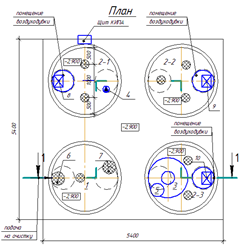
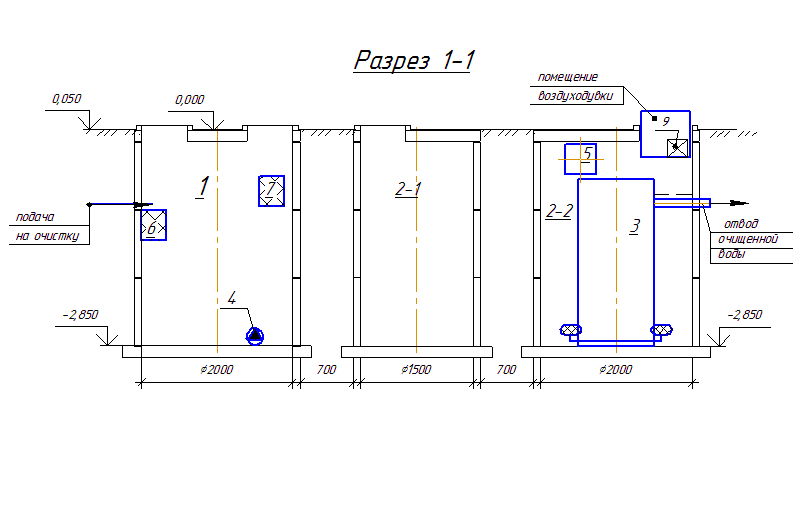
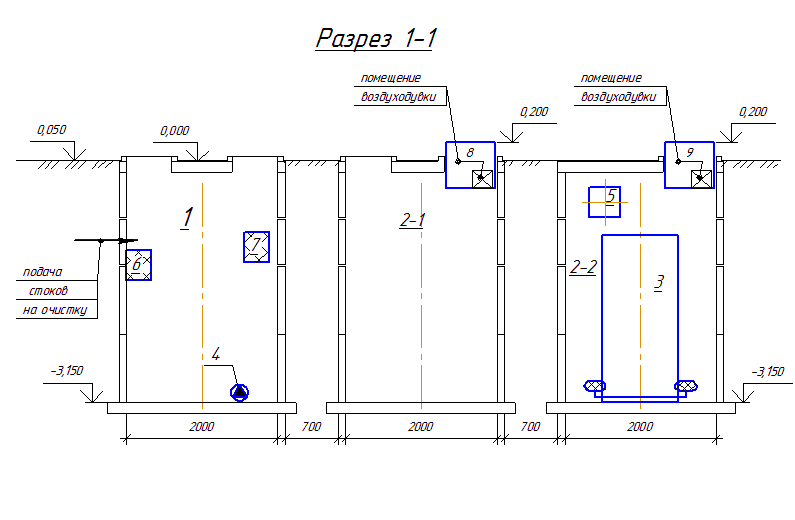
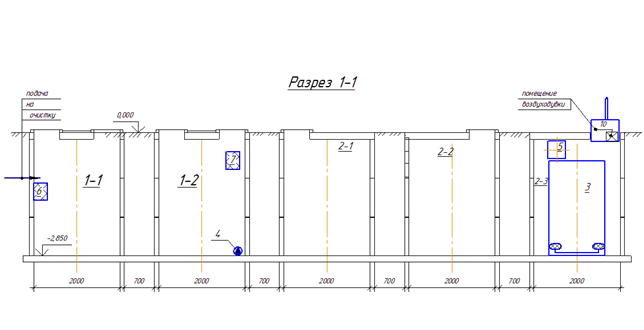
We offer two options for the implementation of a domestic wastewater treatment plant depending on the method of treatment facilities location:
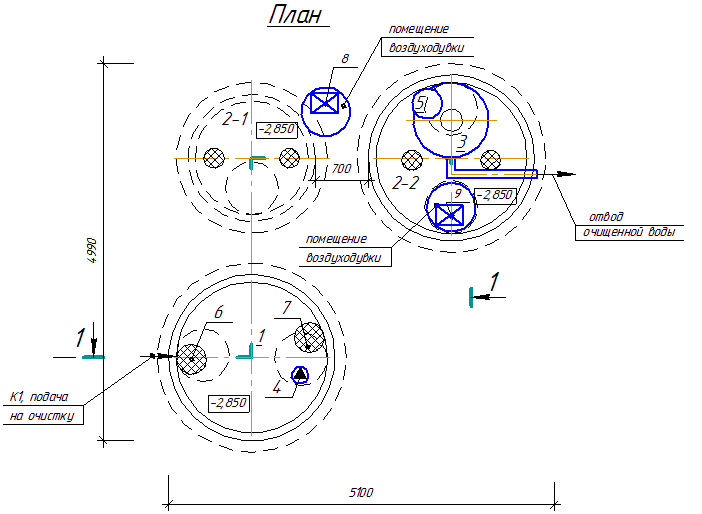
– Combined version of the treatment plant. The main technological tanks are designed from monolithic reinforced concrete, and electrical equipment (blowers) are placed indoors.
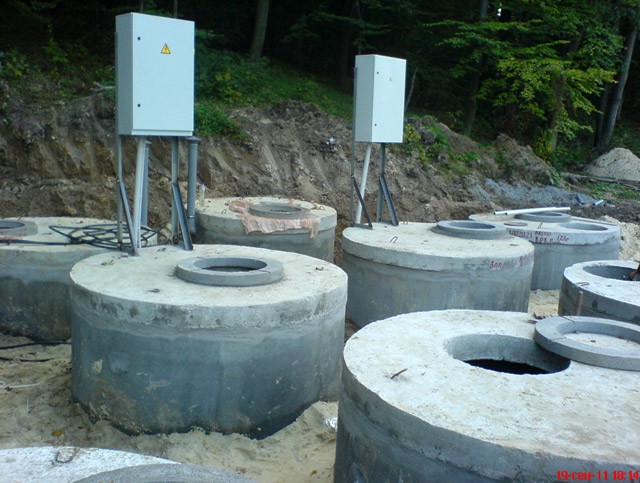
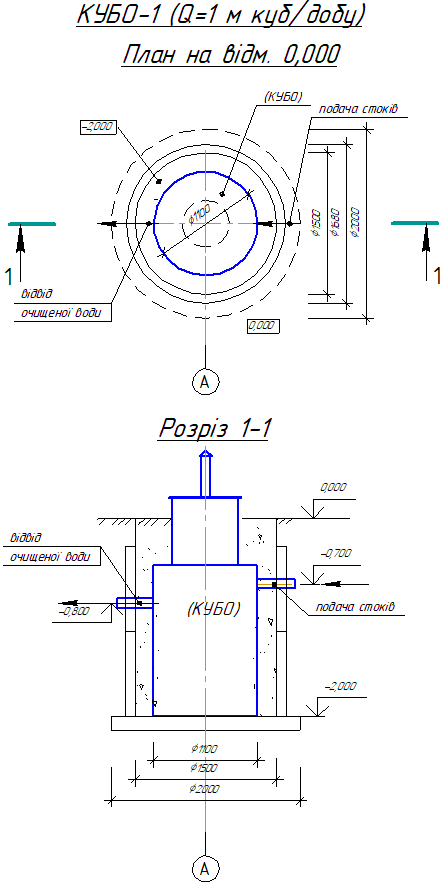
– Underground version of the treatment plant. The main technological tanks are made of plastic and placed in reinforced concrete rings, and electrical equipment (blowers) are placed in a separate block. This option does not require a separate room for technological equipment.
Type
Capacity
Number
Power
units
m3/day
residents (200 liters per person per day)
kW
Installations made of plastic, arranged in reinforced concrete rings (underground version)
KUBO – 1
1
5
0.1
KUBO – 2
2
10
0.1
KUBO – 3
3
16
0.15
KUBO – 5
5
25
0.64
KUBO – 10
10
50
0.91
KUBO – 15
15
75
0.91
KUBO – 20
20
100
1.2
KUBO – 25
25
125
1.3
Installations made of monolithic reinforced concrete, semi-buried or above ground
KUBO – 50
50
250
5
KUBO – 100
100
500
7,5
KUBO – 150
150
750
9,5
KUBO – 200
200
1000
15
KUBO – 300
300
1500
18
KUBO – 400
400
2000
20
KUBO – 500
500
2500
24
KUBO – 600
600
3000
26
KUBO – 700
700
3500
28
KUBO – 800
800
4000
30
KUBO – 900
900
4500
32
KUBO – 1000
1000
5000
36
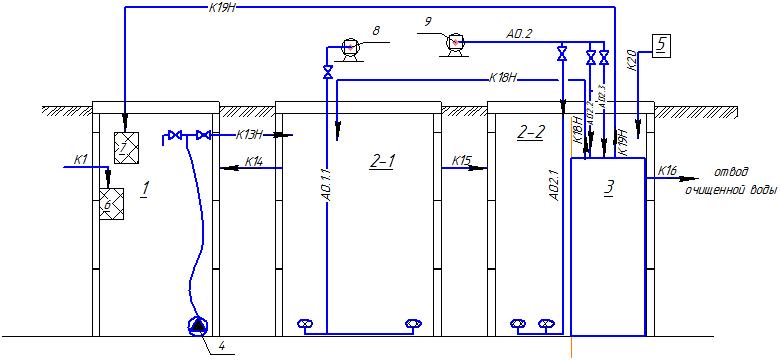
The wastewater enters the averaging tank, where it is accumulated and averaged to provide a uniform flow of wastewater for treatment.
The main treatment is carried out using combined biological methods in a bioreactor. The aerobic bioreactor oxidizes organic contaminants and converts nitrogen compounds into the nitrate form. The oxidation is carried out with oxygen from the air, which is blown in by a blower through a small-bubble pneumatic aeration system. The use of membrane aeration elements in the aeration system can significantly reduce energy consumption and reduce the power of the blower. The service life of membrane aerators is much longer than that of conventional aerators. They are not demanding in operation and do not require specialized cleaning.
Biological treatment in aerobic bioreactors is carried out by a colony of free-floating microorganisms – activated sludge. Removal of retained contaminants takes place in a settling tank. Its design allows for effective separation of the mixture of activated sludge and purified water. According to the requirements of the current standards, the treated water is disinfected with a solution of sodium hypochlorite, which is much safer than free chlorine. The final stage of treatment takes place on a bioplateau.
Purified and disinfected water from KUBO unit can be discharged into a water body, used for watering or washing the territory, etc. In the process of oxidation, the amount of sludge due to the growth of microorganisms and the presence of organic contaminants is constantly increasing. This sludge is called excess sludge. Therefore, part of the sludge (excess activated sludge) is removed from the settling tank and fed for dewatering to a nutsche filter, where it is compacted. The dewatered sludge is periodically discharged from the nutsche filter into a garbage tank and transported to the places designated by local authorities and approved by the Sanitary and Epidemiological Station and the Department of Ecology and Natural Resources.
KUBO WASTEWATER TREATMENT TECHNOLOGIES
Treatment of domestic wastewater of autonomous objects – private houses, villages, cottages, hotels, schools, recreation centers and other local facilities, as well as wastewater similar by chemical composition to them of industrial enterprises by biological methods based on “KUBO” units.
The multi-stage treatment technology was developed on the basis of KUBO units, manufactured according to TU U 37.0-31830396-007: 2015 and approved by the Ministry of Health of Ukraine (Conclusion of the State Sanitary and Epidemiological Expertise of 23.01.2020 # 12.2-18-1/1016).
The size of the sanitary protection zone for KUBO units by capacity of 1-200 m3/day is 5-15 meters.
This wastewater treatment technology allows to provide the effluent quality for further discharge into a fishery reservoir of the 2nd category, a stream or for technical needs (watering green spaces, washing vehicles, etc.) without harmful effects on the environment in compliance with the requirements of current standards.
The treated water is disinfected by solution of sodium hypochlorite according to the requirements of the current standards.
QUALITY INDICATORS OF TREATMENT
#
Name of indicators
Quality indicators of influent
Quality indicators of effluent
1
Suspended solids
350 mg/l
15 mg/l
2
Mineralization
1100 mg/l
1000 mg/l
3
BOD5
300 mg/l
15 mg/l
4
COD
530 mg/l
80 mg/l
5
Synthetic surfactants
4.0 mg/l
0.2 mg/l
6
Ammonium nitrogen
20 mg/l
1.9 mg/l
7
Nitrites
0.7 mg/l
0.27 mg/l
8
Nitrates
40 mg/l
40,0 mg/l
9
Sulfates
200 mg/l
200,0 mg/l
10
Phosphates
10 mg/l
3 mg/l
11
Chlorides
300 mg/l
300 mg/l
12
рН
6.5 – 8.5
6.5 – 8.5
13
Oil products
0.6 mg/l
0.25 mg/l
14
Coli-index
>100000
<1000
14 Coli-index >100000 <1000
* Note. The additional post-treatment unit should be installed to increase the efficiency of wastewater treatment to BOD5 of 3-5 mgO2/l, Suspended Solids of 3 mg/l, and COD of 30 mg/l.
ADVANTAGES OF THE COMPLEX
High treatment efficiency – 95-98%;
Simplicity of operation and maintenance of the equipment;
Small area for treatment facilities location;
No need for additional equipment in the building for the location of treatment facilities;
Short time required for equipment delivery and commissioning;
Low energy consumption;
High quality of treated water that can be used for various technological needs.
TECHNOLOGIES FOR WASTEWATER TREATMENT “KUBO”
TECHNOLOGICAL SCHEME OF KUBO UNITS Q= 5-25 M3/DAY
Treatment of domestic wastewater of autonomous objects – private houses, villages, cottages, hotels, schools, recreation centers and other local facilities, as well as wastewater similar by chemical composition to them of industrial enterprises by biological methods based on “KUBO” units.
The multi-stage treatment technology was developed on the basis of KUBO units, manufactured according to TU U 37.0-31830396-007: 2015 and approved by the Ministry of Health of Ukraine (Conclusion of the State Sanitary and Epidemiological Expertise of 23.01.2020 # 12.2-18-1/1016).
The size of the sanitary protection zone for KUBO units by capacity of 1-200 m3/day is 5-15 meters.
This wastewater treatment technology allows to provide the quality of treated water for further discharge into a fishery reservoir of the 2nd category, a stream or for technical needs (watering green spaces, washing vehicles, etc.) without harmful effects on the environment in compliance with the requirements of current standards.
The treated water is disinfected by solution of sodium hypochlorite according to the requirements of the current standards.
The wastewater enters the averaging tank, where it is accumulated and averaged to ensure a uniform flow of wastewater for treatment. The main treatment is carried out using combined biological methods in a bioreactor. The aerobic bioreactor oxidizes organic contaminants and converts nitrogen compounds into the nitrate form. The oxidation is carried out with oxygen from the air, which is blown in by a blower through a small-bubble pneumatic aeration system. The use of membrane aeration elements in the aeration system can significantly reduce energy consumption and reduce the power of the blower. The service life of membrane aerators is much longer than that of conventional aerators. They are not demanding in operation and do not require specialized cleaning.
Biological treatment in aerobic bioreactors is carried out by a colony of free-floating microorganisms – activated sludge.
Removal of retained contaminants takes place in a settling tank. Its design allows for effective separation of the mixture of activated sludge and purified water.
According to the requirements of the current standards, the treated water is disinfected by solution of sodium hypochlorite, which is much safer than free chlorine.
Treated and disinfected water from KUBO unit can be discharged into a water body, used for watering or washing the territory, etc.